

Introduction
“Anticipation is so much better” - Delta 5, 1980
This blog is dedicated to vinyl: current releases and reissues. I am splitting each review into two parts: Anticipation and Realisation.
Anticipation is so much of the pleasure.
Speaking as someone who spends a ridiculous amount of time digging through charity shops, record fairs and water-damaged boxes labelled “Everything £2”, I’ve come to realise that expectation forms a huge part of my relationship with music. “How much of this stuff do you actually listen to?” someone asked me recently.
Not all of it. Not even half of it.
That isn’t the point.
Finding a classic Nick Lowe single for 50p. Spotting an original copy of Gaye and Other Stories by Clifford T. Ward. Bringing home a Springfields LP for less than the cost of a chicken bake slice from Gregg’s. Those moments provide a peculiar kind of reassurance. Proof that my life happened. Proof that the things I cared about 40 years ago still matter. The rush is immediate. Stronger than any substance or alcoholic drink I’ve encountered.
I pick up a copy of Black Sabbath Vol. 4. A Violinski album rightly disappeared in the mists of time. A rare Lone Justice single. Carmel (yet again, I cannot resist those Serge Clerc covers!). A Madonna single that’s eluded me for decades. Linton Kwesi Johnson. More Specials. Records I’ve loved for years. Records I’ve never come across before. The familiar. The elusive. The unexpected. And the music is already playing in my head.
I have aphantasia. I cannot conjure visual images in my head. I possess no visual memory. But music, I know. Sometimes it’s a record I know intimately. Sometimes it’s a record I’ve never heard before. It doesn’t matter. The expectations begin firing instantly. Possibilities. Connections. Half-remembered stories. Imaginary sounds. That’s where the magic lives.
And for me, the artefact has to be physical.
Vinyl, preferably (but CDs and cassettes work too). A stream on a screen does not. Fairly or unfairly, the spell refuses to work the same way.
People ask if I regret selling my record collection.
Mostly no.
I miss my copies of Au Pairs, Transmitters, Cassius Clay, Sonic Youth, The Mob records. But the thrill of rediscovery outweighs the regret. Finding a favourite again after 30 years. Wondering whether it will sound as glorious as it does in my head.
And if I never find it again?
So what?
There is always something else waiting. New, old, whatever. Another record to discover. Another possibility to imagine. Another expectation to nurture.
After all, anticipation is so much better.
24. Various Artists
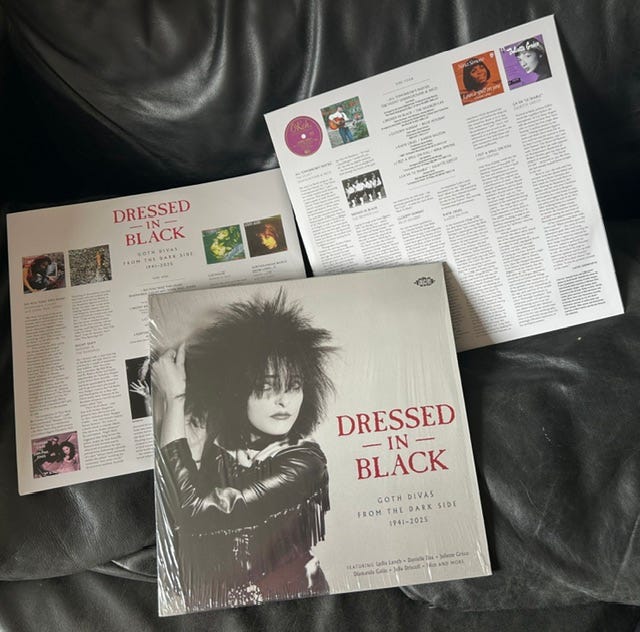
Dressed In Black: Goth Divas From The Dark Side 1941-2025 (Ace)
Anticipation
OK. Even if I hadn’t heard this, I have heard this. Much of this. Danielle Dax, Lydia Lunch, Nina Simone, The Shangri-Las, Bobbie Gentry, Cocteau Twins, Billie Holiday, Karen Dalton, Nico, Julie Driscoll, Siouxsie and the Banshees, The Cramps... and so forth. More to the point, I know precisely what most of this music sounds like. I do not need anyone to tell me how extraordinary ‘Night Shift’ is, or ‘Ode To Billie Joe’, or ‘Gloomy Sunday’, or ‘Cat-House’. Some of these records have been hanging around my life for decades. I expect most of them will be hanging around long after I’ve gone, too.
But the curation! The attention to detail! The putting together into a whole! That is what I have been looking forward to here, because this isn’t some dimwitted NOW THAT’S WHAT I CALL GOTH exercise where Bauhaus turns up four songs after The Sisters Of Mercy and everyone goes home happily agreeing that black is a very nice colour indeed. This is Goth Queen, writer Cathi Unsworth proposing something far more expansive and enticing: goth as lineage, goth as sensibility, goth as a way of looking and listening that existed long before anyone thought to give the music a name or turn it into a uniform.
This matters because Dressed In Black grew out of Cathi’s magnificent Season Of The Witch: The Book Of Goth, and is a companion piece to it. While writing that book she began following the music backwards, towards previous generations of what she wonderfully calls the “gothmothers”. That trail doesn’t stop conveniently at punk or glam or The Doors. It keeps going. Back through psychedelia, girl groups, murder ballads, folk music, jazz, chanson, Southern Gothic, the blues, and, if you follow Shirley Collins’ ‘Death And The Lady’ far enough, towards the Black Death itself.
That feels right to me. Goth didn’t suddenly spring fully formed from a crypt sometime around 1979 wearing fishnets and carrying a Bauhaus 12-inch. The darkness was already there. The theatricality was already there. Anyone who has visited Preston Park Manor can tell you. The alienation and ambiguity and fascination with death and glamour and outsiders were already there. Centuries old. The women were most certainly already there.
This is not 19 tracks assembled because somebody noticed they could think of a sufficiently clever title. It’s the connections between them that matter, and the bloody physical thing itself. The sumptuous packaging! The gorgeous vinyl! The Ace sleeve notes! The blackness! The two records! The photographs! The typography! The feeling that someone has actually thought about what happens when you turn from one page to another, and what happens when one voice gives way to the next.
I know I’m supposed to pretend that delivery systems are irrelevant and music is music is music, whether it squirts anonymously from a telephone speaker or comes spinning out of two generous slabs of vinyl, but I don’t believe that and never have. Context changes listening. Sequencing changes listening. Objects change listening. Reading Cathi’s notes while the record is playing changes listening. The format creates punctuation. The end of Side One is an ending. The beginning of Side Two is a beginning. When you reach Side Four, you have arrived somewhere.
And what a journey to anticipate. Diamanda Galás with John Paul Jones into Siouxsie and the Banshees into Danielle Dax into Anita Lane and Die Haut. Lydia Lunch and Rowland S Howard, Annie Hogan, The Cramps, Judy Henske and Bobbie Gentry. Julie Driscoll through Anna Calvi and Shirley Collins to M U M M Y and Cocteau Twins. And then Side Four. Oh, Side Four. The Velvet Underground & Nico, The Shangri-Las, Billie Holiday, Karen Dalton, Nina Simone and Juliette Gréco. It reads less like a track listing than someone emptied a magnificent section of my record collection onto the floor and then discovered a hidden system connecting everything.
And I have heard this. Here is what I wrote for Classic Rock:
Dressed In Black is the kind of collection that feels inevitable once you hear it, as though these artists were always destined to inhabit the same shadowy room.
That’s it, really. That’s the anticipation.
Not: Will this be any good?
Come on. Look at it.
The question is: what happens when you put all these records in the same shadowy room?
Realisation
The answer is that they recognise one another.
That’s the real pleasure of Dressed In Black. Not surprise. Recognition. That lovely sensation when somebody makes explicit a series of connections you’ve understood instinctively, half-consciously, all along. You hear the lineage because Cathi isn’t simply telling you it exists. She is putting the evidence on the turntable.
Take Billie Holiday and Lydia Lunch. Put ‘Gloomy Sunday’ onto a Billie Holiday collection and it’s one extraordinary performance among many. Place it here, in a sequence containing Lydia Lunch, and another trail illuminates. Lydia took ‘Gloomy Sunday’ into the jazz-noir world of Queen Of Siam in 1980. Suddenly the line from 1941 to downtown New York isn’t being proposed as some clever academic connection. You can bloody well hear it.
Likewise Julie Driscoll and Siouxsie. Cathi’s sleevenotes have Siouxsie describing being besotted by Driscoll, by the way she looked and by the voice, and then you hear ‘Season Of The Witch’. You listen to Driscoll’s voice, the drama and command of it, and then listen to Siouxsie. There is continuity here without imitation. Influence without servitude. One woman showing another younger woman that music could contain this particular kind of presence.
This is what Cathi’s book and this compilation both understand: influence isn’t necessarily a straight family tree with little lines connecting A to B to C. Culture doesn’t work like that. It leaks. Something catches your eye when you’re 15. A voice gets inside your head. A record suggests that the rules you’ve been given aren’t actually rules. A look tells you that you are permitted to invent yourself differently. Years later you make something else, and somebody younger sees or hears you and the whole process starts again.
So of course The Shangri-Las are here. How could they not be? (It’s the title, duh!) Teenage tragedy, motorcycles, black clothes, doomed romance, melodrama, death around every corner and records that sound like someone has somehow crammed an entire lurid B-movie into less than three minutes. Mary Weiss talked about the group’s “tremendous dark side”, and you don’t need hindsight to hear it. ‘Dressed In Black’ isn’t goth because this compilation has retrospectively pinned a bat-shaped badge onto it. It is here because the emotional and imaginative territory claimed by goth was already being occupied.
Bobbie Gentry’s ‘Ode To Billie Joe’ works similarly. One of the great mysterious records, and one whose refusal to solve its central mystery is inseparable from its power. What was thrown from Tallahatchie Bridge? We’re never going to know. We shouldn’t ever need to know. The mystery creates the space around the song. That sultry suspended atmosphere, the unbearable casualness with which catastrophe enters ordinary conversation, the entire landscape seeming to harbour something nobody is quite prepared to articulate. This is properly, magnificently Southern Gothic.
And then Danielle Dax. Oh, Danielle Dax. ‘Cat-House’ still sounds preposterous and wonderful, simultaneously rock’n’roll and something that has crawled in through rock’n’roll’s bathroom window. Cathi’s notes make the strangeness richer rather than explaining it away: the Essex childhood, the grandmother who was a medium, the “Inky Bloaters”, the occult books, Lemon Kittens, making Pop-Eyes herself, appearing in The Company Of Wolves, the utterly individual path that eventually led ‘Cat-House’ to Seymour Stein. This is exactly what I want from sleeve notes. Not a solemn man explaining why an Important Record is Important. I want doors opening. I want to stop halfway down the page and think, hang on, I didn’t know that.
I want to put another record on.
And another.
And another.
That is curation.
This is another reason Dressed In Black works. Canonisation can neuter records. Once something becomes an acknowledged Classic, it gets framed, filed away, incorporated into lists, given anniversary editions and documentaries, and eventually there’s a danger we stop listening to the bastard thing. It becomes a signifier for itself. Dressed In Black doesn’t do that. Put ‘Night Shift’ after Diamanda Galás and before Danielle Dax, and it gets to be a record again. A violent, astonishing, deeply strange record.
And the whole compilation continues making these sidelong connections. Poison Ivy and Lux Interior digging through disreputable corners of American music and making old records sound futuristic. Lydia Lunch and Rowland S Howard meeting somewhere between no wave, noir and a disreputable motel room. Anita Lane and Die Haut inhabiting that extraordinary Berlin hinterland. Judy Henske’s magnificent ‘Road To Nowhere’ proving once again that anyone who thinks darkness suddenly arrived with post-punk simply wasn’t paying attention.
Side Three begins with Julie Driscoll, Brian Auger & The Trinity’s ‘Season Of The Witch’, all seven minutes and 54 seconds of it. There is something gloriously extravagant about having the room to let this record stretch out on vinyl. It doesn’t function as historical evidence. It lives.
Shirley Collins’ ‘Death And The Lady’ makes the historical perspective stretch almost absurdly far backwards. Here is an ancient song about the one visitor nobody can refuse, carried across centuries because people kept singing it. Gothmother indeed. There is something wonderful about placing English traditional song within this continuum without treating it as some dusty ethnomusicological artefact.
And then, wonderfully, M U M M Y’s ‘Idiot Milk’ brings the line right up to 2025. Another smart piece of curation. This can’t be allowed to become heritage culture, a mausoleum containing the approved Great Women Of Darkness. The line keeps moving because of course it does. M U M M Y, Jo Spratley and Christian ‘Bic’ Hayes, bring with them another network of connections through Cardiacs, Spratleys and English psychedelic oddness. File under Psychodrama, Cathi’s notes say. Play loud, at night. Fair enough.
That is part of what goth gave us too, surely. The permission not to explain everything. The understanding that ambiguity has value. That mystery is not a failure of communication. That beauty doesn’t have to sit obediently beneath a fluorescent light so we can inspect its workings.
Finally, Juliette Gréco. Gréco’s presence stretches the lineage sideways again, into French chanson, Saint-Germain-des-Prés and a very different tradition of performance. And then comes the line that ought really to be written in gigantic letters across the inside of the gatefold:
“Black provides space for the imaginary.”
Sometimes you get exactly the record you were hoping you were going to get.
There is absolutely nothing wrong with that.
You know the dress code.
Buy here. You will not find a greater compilation all year. It’s only 13 quid!
To Cathi Unsworth, and you, many thanks